Maine Coon vs Bobcat in Real Hands-On Experience
I have worked as a wildlife rehab technician in a rural Pennsylvania facility for over a decade, and I’ve handled both large domestic cats and injured wild felines that look far more intimidating than they behave. The comparison between a Maine Coon and a bobcat comes up more often than people expect, especially from visitors who see size alone and assume similarity in behavior.
In my day-to-day work, I’ve had to explain where the resemblance ends and where it becomes a serious misunderstanding of wild instincts. I’ve also worked alongside breeders and rescue networks dealing with large Maine Coons that surprise people with their strength.
Physical build and instinct differences, I notice immediately
The first time I placed a sedated young bobcat in a recovery enclosure after treatment for a minor leg injury, I was struck by how different it felt compared to any domestic cat, even the largest Maine Coons I had seen in breeder programs. A bobcat has a compact, muscular structure built for bursts of power, and even at under 30 pounds in most cases, it carries itself like something much heavier. Maine Coons, on the other hand, often reach 15 to 25 pounds, with a long, flowing frame that makes them look bigger than they are. I’ve weighed a few males from local breeders that pushed close to 22 pounds, and even then, the difference in bone density was obvious.
One winter, I assisted with intake for a bobcat that had wandered too close to farmland and gotten caught in a fence. It was not aggressive in a wild, chaotic sense, but every movement was calculated and reactive in a way domestic cats rarely are. Even calm bobcats stay mentally alert in a locked-in survival mode that Maine Coons simply do not possess. Maine Coons may be confident and even stubborn, but they still operate within the behavioral framework of domestication. The gap in instinct is not subtle once you’ve worked hands-on with both.
People sometimes ask me if a Maine Coon could “turn into” a bobcat with enough size or environmental influence, and I always answer the same way: size alone does not change wiring. A cat born and raised in human environments, even a very large one, lacks the survival-driven decision-making that defines wild felines. Bobcats rely on that wiring every second they are awake. Maine Coons rely on learned behavior and human interaction patterns.
Behavior in handling situations and controlled environments
When I work with injured wildlife, I follow strict handling protocols, and bobcats require an approach entirely different from that for domestic cats. Even under sedation or partial recovery, their reactions to sound and movement are sharper and more immediate. Maine Coons can be stressed during transport or vet visits, but they tend to show predictable domestic responses, such as freezing, vocalizing, or trying to retreat rather than escalating the situation. I once had a Maine Coon brought in after a minor accident, who spent the entire exam loudly “complaining” rather than resisting physically.
In a controlled setting, I’ve seen bobcats recover from anesthesia and immediately begin testing enclosure boundaries, pacing with purpose, and assessing every corner as a possible exit. A Maine Coon in the same situation usually seeks comfort spots, often curling into bedding or staying close to a familiar scent. That difference matters more than people realize when designing recovery spaces or enrichment environments. I remember a case where a bobcat required three layers of reinforced enclosure panels, while a large domestic cat recovering from surgery stayed safely within a standard recovery kennel without issue.
During a training exchange with a local animal shelter last spring, I explained these differences to staff who mostly dealt with surrendered pets. We even compared notes on Maine Coon temperament, which is often calm but vocal, and I pointed out that behavioral consistency is one of the clearest dividing lines between domestic breeds and wild species. For staff wanting structured guidance on handling large or unusual cats, I often point them toward maine coon vs bobcat as a general reference point for safety preparation and handling fundamentals in animal care settings. The key takeaway I shared with them was simple: predictability is the real separation, not size.
A bobcat never fully relaxes in captivity the way a Maine Coon can. Even after recovery, there is always a layer of environmental scanning happening. Maine Coons might be cautious at first, but they settle into routines quickly, especially if food and human interaction are consistent. That difference becomes very clear after you’ve spent enough time around both species in non-ideal conditions like transport crates or medical holding areas.
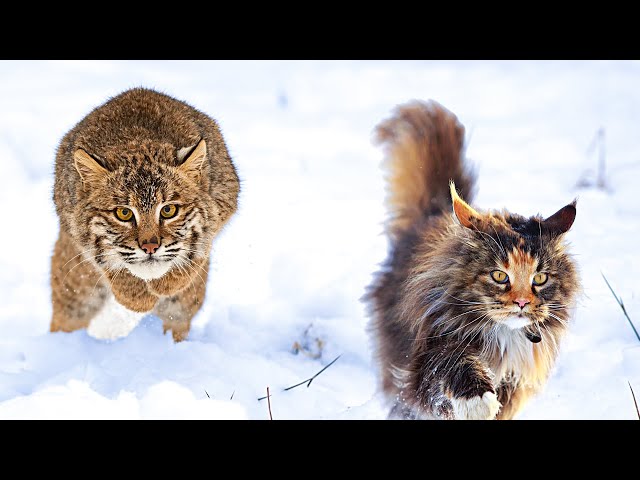
Common misconceptions people still repeat
One of the most common misunderstandings I hear is that Maine Coons are “almost wild cats” because of their size and tufted ears. I’ve worked with breeders who produce cats that look impressive enough to spark that assumption, especially males with thick winter coats. But domestication changes behavioral wiring over generations, and that cannot be reversed by appearance alone. Even the largest Maine Coon I handled, a 24-pound male from a breeding program, behaved more like an oversized companion animal than anything remotely wild.
Bobcats are frequently misjudged in the opposite direction. People sometimes assume they are just “feral house cats,” which is far from accurate. A bobcat’s survival behavior includes territorial awareness, hunting reflexes, and stress responses that are not present in domestic breeds. I’ve seen injured bobcats recover enough to show immediate hunting focus toward small movement outside enclosures, something no domestic cat I’ve worked with has ever demonstrated in the same way.
There’s also the myth that hybridization or extreme environments can blur the line between the two. In reality, even when domestic cats survive in harsh outdoor conditions, they do not become a wild species. They adapt within domestic limits. I’ve monitored stray colonies for weeks during field support work, and while some cats become cautious and resourceful, they still behave within a domestic behavioral spectrum. The bobcat remains structurally and instinctually separate.
What years of side-by-side experience have taught me
After working with both species in overlapping environments, I’ve learned that comparison only works at a surface level. Size, ear shape, and coat patterns can create visual overlap, but behavior tells a completely different story. Maine Coons fit into human environments with relative ease once trust is established. Bobcats never fully transition into that pattern, no matter how calm they appear during brief interactions.
I still remember one late-autumn intake when we had a recovering bobcat in one enclosure and a large Maine Coon in another, both under observation for unrelated reasons. The Maine Coon adjusted within a day, responding to staff presence and feeding schedules with familiarity. The bobcat remained alert the entire time, even during rest periods, tracking movement and sound in a way that suggested constant evaluation of escape options. That contrast stayed with me because it wasn’t about aggression; it was about depth of instinct.
People often want a simple ranking of which one is “stronger” or “better,” but that misses the real point. They are not operating in the same category of animal behavior. One is shaped by domestication and long-term human companionship. The other is shaped by survival in the wild, even when temporarily placed in human care. I’ve learned to respect both for what they are rather than what people assume they resemble.
After enough years working in rehab environments, the comparison stops being about appearance and becomes about understanding boundaries that nature does not blur, even when humans try to imagine otherwise.