Rare Cat Eye Colors I Keep Seeing in Clinic Cases and Breeding Consults
I work as a feline grooming specialist and part-time consultant with a small cat genetics rescue program. Over the years, I’ve handled thousands of cats coming through grooming sessions, shelter assessments, and breeder evaluations. One thing that still catches my attention is how varied and unusual cat eye colors can be. Some of them look almost unreal when you see them in natural light. I’ve learned to read those colors not just as aesthetics but as clues about genetics, health, and breed history.
How rare eye colors actually form
Most people assume cat eye color is just about breed, but I’ve found it is more about pigment concentration and genetics working together in layers. Melanin distribution in the iris decides whether a cat ends up with copper, green, blue, or something more unusual, like odd-eyes. In several clinic cases I’ve reviewed, kittens from the same litter can show completely different eye tones even when coat color looks nearly identical. That variation always reminds me how unpredictable feline genetics can be.
In one rescue intake last spring, I handled a young domestic cat with one blue eye and one amber eye. The caretaker thought it was a sign of illness, but after a full checkup and history review, it turned out to be a harmless genetic condition called heterochromia. Cases like that are rare but not dangerous. I’ve seen that before. It’s fascinating how often people mistake uniqueness for disease.
For anyone trying to understand these unusual traits more deeply, I once referred a breeder client to a feline ophthalmology resource that helped them separate cosmetic variation from medical concerns during early kitten evaluations. That kind of guidance matters when you are trying to avoid misreading natural genetic traits as health problems. I still recommend structured references like that during consultations because visual traits alone can be misleading without context.
Blue eyes beyond common breeds
Blue eyes are often associated with Siamese-type cats, but I’ve seen them in several unexpected breeds. White-coated cats, especially those with dominant white genes, sometimes carry bright blue eyes that look almost glass-like under indoor lighting. In my grooming work, I’ve noticed that clients often assume that blue eyes always indicate partial deafness, which isn’t always true. The reality is more complex and depends on multiple genetic factors interacting simultaneously.
During one shelter evaluation, I worked with a white domestic shorthair with deep sapphire-blue eyes and no hearing issues. The staff initially flagged the cat for further testing, but behavioral observation confirmed normal auditory response. That case stayed with me because it challenged many assumptions I had also heard repeated for years. Blue eyes alone do not define a cat’s sensory health, even if the correlation exists in certain lines.
In breeding circles I’ve visited, blue-eyed cats are often selectively bred for appearance, but responsible breeders still carefully monitor health lines. The balance between aesthetic traits and genetic stability is always delicate. I’ve seen some breeders prioritize eye color so heavily that it created unintended coat or immune system issues down the line. That tradeoff is rarely discussed outside professional circles.
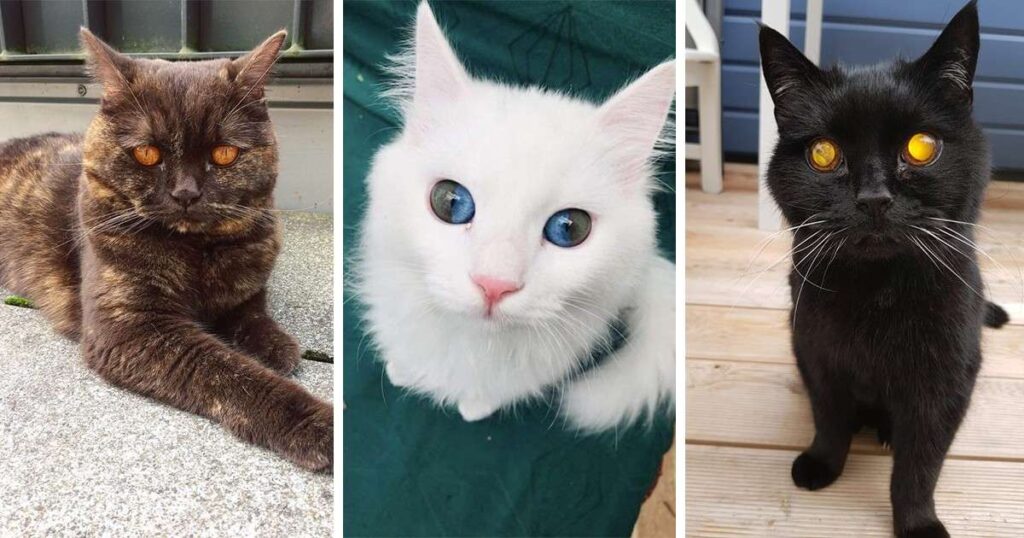
Odd-eye cats and the genetics behind them
Odd-eye cats are among the most striking animals I’ve handled in my career. One eye appears blue while the other ranges from green to amber to copper. This condition is most commonly seen in white cats because pigment cells migrate during early development. I’ve worked with several cats like this in grooming sessions, and they always draw attention the moment they walk into a room.
The most memorable case I had involved a rescue cat that lived in a foster home with three other animals. The foster caregiver initially thought the difference in eye color was due to injury or infection, but veterinary checks confirmed it was genetic heterochromia. That cat had one brilliant turquoise eye and one warm golden eye, which created a striking contrast in sunlight. I still remember how calm the cat was during grooming, despite constant attention from visitors curious about its appearance.
Odd-eye traits are not always purely cosmetic from a breeder’s perspective, since they can be linked to pigmentation pathways that also affect hearing in some white-coated lines. That is why careful evaluation matters before assuming it is just a visual trait. In my experience, most odd-eye cats live completely normal lives without complications, but early screening still helps rule out hidden issues that may not be obvious during casual observation.
Amber, copper, and shifting tones
Amber and copper eyes are more common than people think, but true deep copper tones with high clarity are less frequently seen outside certain breeds, such as British Shorthairs. I’ve handled many cats whose eye color seemed to shift slightly with lighting, making identification tricky even for experienced handlers. In natural daylight, those eyes often appear richer and more saturated than under artificial indoor light.
One boarding client last year brought in a cat with what they called “golden flame eyes,” and while that sounded dramatic, the description was not far off. The eyes had a layered copper tone that almost reflected orange highlights when the cat moved. That cat also had a calm temperament, which made handling during grooming sessions very smooth. I’ve noticed that owners often become very emotionally attached to this eye color category more than others.
Genetically, these warmer tones are tied to pigment density in the iris, but the exact shade variation still surprises me in real-world cases. I’ve seen siblings from the same litter develop slightly different copper shades that only become noticeable after a few months of growth. That slow change is something many first-time cat owners do not expect.
Rare eye colors always remind me that cats are not uniform in how they express their traits. Even within predictable genetics, there is always a layer of variation that emerges only over time, in different environments, and through subtle biological shifts.