Frankincense and Cats: What I’ve Seen in Homes and Clinics
I work as a small-animal veterinary technician in a busy clinic, where I regularly treat pets exposed to essential oils at home. Frankincense comes up more often than people expect, especially with cat owners trying natural remedies or calming scents. I’ve seen everything from harmless curiosity to real respiratory irritation in sensitive cats. My experience has taught me to treat this topic with caution rather than assumptions.
What frankincense does around cats
Frankincense is an essential oil derived from tree resin, and people often use it for relaxation or spiritual practices. In homes with cats, the problem is not the scent itself but how the oil behaves in a closed indoor space. Cats have a very different liver metabolism from humans, which means they process certain compounds more slowly. I have seen cats react just from light exposure in poorly ventilated rooms.
One customer last spring kept a diffuser running in a small bedroom where her cat also slept. She thought the diluted mist would be harmless because the oil was “natural.” Within a day, the cat started sneezing and hiding under the bed, which is a classic stress response I see in clinic visits. That case didn’t require emergency treatment, but it made her rethink how she used essential oils around pets.
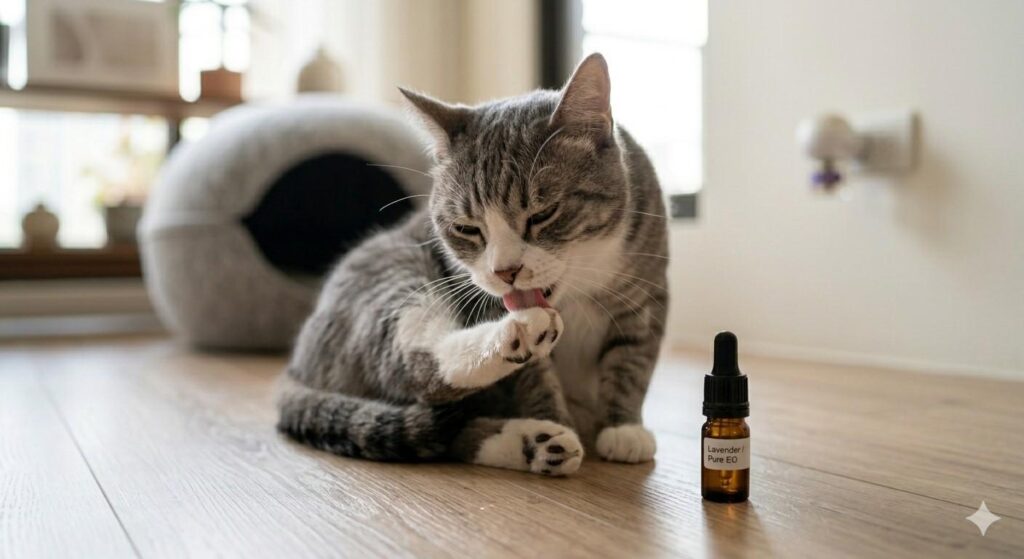
The concern with frankincense is not always direct toxicity, but respiratory sensitivity and long-term exposure risks. Cats groom themselves constantly, so any residue that settles on fur can be ingested later. I usually explain to owners that what feels like a mild scent to us can be much more concentrated for a cat living closer to the floor. This difference alone changes how I advise people to use such products.
Diffusing oils in a home with cats
Diffusers are the most common way I see frankincense introduced into homes, and they are also where most problems begin. The mist spreads fine particles into the air, and cats cannot easily escape exposure if the space is small or poorly ventilated. Even intermittent use can lead to buildup on fabrics and surfaces over time. I’ve had cases where symptoms only appeared after weeks of regular use.
In one household I visited for a routine checkup, the owner was using multiple essential oils throughout the day. The cat was not eating well and had become unusually withdrawn. After a bit of discussion, we traced the issue back to a rotating diffuser schedule in the living room. She stopped using it immediately and saw improvement within a few days.
For anyone researching safer practices, I often suggest consulting a local veterinary resource or a poison control service before introducing any oil into a pet’s household. Pet Poison Helpline. This kind of guidance helps clarify exposure risks based on your specific setup rather than general advice found online. I have seen people adjust their entire home routine after a single consultation. That small step can prevent repeated exposure mistakes.
Airflow matters more than most people think. Even a slightly open window can significantly reduce concentration levels. Still, I don’t rely on ventilation alone as a safety measure because cats tend to stay in warm, enclosed spots where air movement is minimal. That is usually where exposure becomes most consistent.
What I see in clinic cases
In my clinic work, frankincense exposure rarely shows up as a dramatic emergency, but it does appear in subtle respiratory complaints. Cats may present with mild coughing, watery eyes, or behavioral changes, such as avoiding certain rooms. These symptoms are often mistaken for allergies or stress unrelated to the environment. That is where history-taking becomes very important.
I remember a middle-aged tabby brought in for what the owner thought was seasonal sneezing. After asking a few questions, I learned they had started using frankincense oil in a bedside diffuser about two weeks earlier. The timing matched perfectly. Once the diffuser was removed, the symptoms gradually settled without medication.
Another pattern I see is skin irritation when oils settle on bedding or blankets. Cats lie in the same warm spots for hours, and that repeated contact can lead to mild dermatitis. It is not always obvious at first because cats groom themselves quickly, hiding early signs. By the time owners notice, the irritation has usually been building for days.
One important thing I’ve learned is that cats rarely “adapt” to essential oils. If anything, prolonged exposure tends to increase sensitivity. A cat that tolerates it one week may react strongly the next after cumulative exposure. That inconsistency is part of why I stay cautious when advising pet owners.
Safer choices, I suggest
When people ask me directly whether frankincense is safe for cats, I don’t say it’s safe or unsafe in isolation. I frame it in terms of exposure risk and individual sensitivity. Some cats may show no immediate reaction, but that does not guarantee long-term safety. My approach is to reduce unnecessary exposure whenever possible.
I usually recommend scent-free environments as the baseline for households with cats. If someone wants a calming atmosphere, there are alternatives like gentle airflow, soft lighting, or pheromone-based diffusers designed specifically for feline use. These tend to create fewer complications in my experience.
Another practical step is to keep any scented products completely out of closed sleeping areas. Even occasional use in shared spaces can accumulate over time, especially in smaller homes or apartments. I have seen noticeable improvement in cats simply from removing one or two daily exposure sources.
Simple habits matter. Open windows for short periods. Keep fabrics clean. Avoid continuous diffusion. These adjustments reduce risk without requiring a complete lifestyle change. Most owners I work with find that small changes are easier to maintain than strict avoidance rules, and they still see better outcomes for their pets.
I don’t treat frankincense as an immediate danger in every case, but I also don’t treat it as harmless in a cat environment. The truth sits somewhere in the middle, shaped by ventilation, frequency, and the individual cat’s sensitivity. Over time, I’ve learned that caution is usually the quieter, safer choice in homes where animals cannot explain what feels wrong.