Are Money Trees Toxic to Cats? What I Tell Pet Owners Based on What I See Daily
I work as a mobile veterinary assistant, spending most of my days driving between homes, helping cat owners resolve small emergencies and preventable issues. Over the years, I have walked into dozens of living rooms where a perfectly healthy-looking plant was sitting next to a curious cat. The money tree is one of those plants I get asked about surprisingly often. People usually want a straight yes-or-no answer, but real situations are often a bit more layered than that.
What a money tree actually means for a curious cat
In my experience, most people refer to the money tree as Pachira aquatica, a popular indoor plant with braided trunks and glossy leaves. I’ve seen it in offices, apartments, and small cafés where cats roam. I tell clients that money trees are considered non-toxic to cats by veterinary poison control references, but that doesn’t guarantee they’re harmless in all cases.
Cats do not read plant labels. Last spring, a client called after her young tabby chewed a few money tree leaves. The cat had mild vomiting and stomach irritation for a day, but showed no signs of poisoning. This pattern—digestive upset rather than poisoning—is common after cats eat plant material.
Even non-toxic plants can cause problems if cats eat them. Money tree leaves are thick and fibrous, and chewing them can irritate the stomach. I remind people that non-toxic means no known chemical toxicity risk, not that it’s safe for cats to eat as they please.
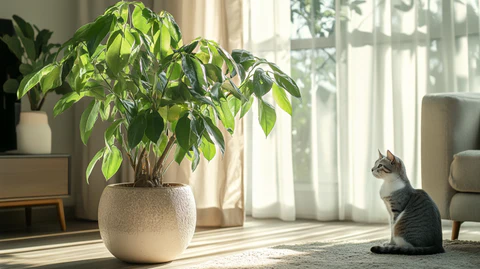
Why do cats still react even when the plant is safe
One afternoon, I visited a home where a pair of indoor cats had knocked over a medium-sized money tree sitting near a window. The owner was worried about poisoning because one of the cats was drooling and acting restless. After checking the plant and the symptoms, it turned out to be mild gastrointestinal irritation from chewing the leaves, combined with stress from the falling pot.
During cases like that, I often suggest getting a quick professional check through a local clinic or a trusted veterinary support service, such as a pet health consultation service. It helps owners confirm whether symptoms are from toxicity or just digestive upset and stress, especially when plants are involved in the incident. That clarity usually reduces panic quickly and helps everyone focus on simple care steps.
Many cat owners are surprised that reactions are often behavioral, not toxicological. A cat may vomit after chewing plant fibers simply due to difficulty digesting them, not poison. I have seen the same cat react differently to the same plant based on hunger, boredom, or anxiety.y.
I also notice that younger cats are far more likely to interact with money trees. They treat them like toys, not food. One household I visited had a six-month-old kitten who used the braided trunk as a climbing post. The plant survived, but only barely, and the kitten ended up with a slightly upset stomach after chewing bark.
Signs I watch for when a cat eats a money tree
When I arrive at a home after a plant-chewing incident, I focus less on the plant itself and more on the cat’s behavior over the next few hours. Most money tree cases do not escalate into anything serious, but I still look for patterns like repeated vomiting, lethargy, or refusal to eat. Those signs usually tell me whether we are dealing with simple irritation or something more concerning.
In one case, a cat owner thought the plant was the problem, but the real issue was hairballs exacerbated by stress. The timing made it look like the money tree was responsible, but the symptoms started before the cat even reached the plant. That kind of overlap is common, and it is why I always ask about the full day’s behavior, not just the moment the plant was involved.
Most cats recover within a few hours if the issue is mild. I usually recommend keeping the cat away from the plant temporarily and offering fresh water. If vomiting persists beyond a short window or if the cat becomes unusually quiet, I suggest a proper veterinary exam rather than waiting it out at home.
How I help owners prevent plant and cat conflicts at home
Over time, I have noticed that prevention is less about removing plants and more about placement and distraction. Money trees are often placed in sunny corners, which are also prime exploration spots for cats. Moving the plant even a small distance can reduce interest dramatically in some homes.
In multi-pet households, I often recommend creating a few designated green zones that cats are not naturally drawn to. That might mean higher shelving, or simply placing plants near areas cats already avoid. It is not about restricting the cat’s entire environment, but about designing it so curiosity does not always lead to chewing or knocking things over.
Another thing I tell owners is that boredom plays a bigger role than people expect. A cat with enough stimulation is less likely to test every plant in the room. Simple changes, such as rotating toys or adding climbing spaces, reduce plant-related incidents more effectively than most people assume.
I also remind owners that, even though money trees are not toxic to cats, repeated chewing can shorten the plant’s lifespan and create an unnecessary mess. I have seen perfectly healthy plants slowly stripped of leaves simply because a cat decided it was part of its daily routine. That is usually when owners finally decide to relocate the plant entirely.
In summary, money trees are not toxic to cats, but problems often arise from curiosity and plant placement rather than the plant itself. If owners act early and address behavior, both the cat and the plant can thrive together.