What Are the Main Differences Between Tonkinese and Siamese?
I have spent years working with cats at a multi-cat boarding cattery, where Tonkinese and Siamese were among the most commonly dropped off breeds. Owners often asked me to explain the real difference between the two, especially when their personalities seemed so similar at first glance. Over time, I noticed patterns in behavior, energy levels, and even how they bonded with people in shared spaces. Those day-to-day observations shaped how I understand Tonkinese vs Siamese beyond textbook descriptions.
Temperament in real homes
In my experience, Siamese cats tend to be more vocal and demanding in a direct, almost conversational way. I have had Siamese cats that would follow me from kennel to kennel, commenting loudly on anything they felt was off schedule. Tonkinese cats, while still social, usually express themselves with softer communication and more physical closeness than constant vocalization. A Siamese will talk at you, while a Tonkinese often prefers to sit on you.
One thing I noticed during long boarding stays is how differently they handle attention distribution in busy environments. Siamese cats often try to monopolize human interaction, showing clear frustration when they feel overlooked for even a short time. Tonkinese cats adapt a bit more easily, sometimes rotating between people or settling into calmer observation if attention is shared. That difference becomes more visible in homes with multiple pets or children.
Energy levels overlap, but the expression differs in practice. Siamese cats can feel sharper in their bursts of activity, darting through spaces with focused intent. Tonkinese cats still play intensely, but their movements often feel smoother and more rounded rather than tightly reactive. I once had a Siamese who would repeatedly scale the enclosure shelves within minutes, while a nearby Tonkinese preferred interactive play with me over solo sprinting.
Genetics and physical traits
Working closely with breeders who occasionally brought their cats for health checks, I learned to spot subtle structural differences between Tonkinese and Siamese cats. Siamese cats generally have a more elongated frame, a wedge-shaped head, and a strikingly narrow bone structure. Tonkinese cats tend to sit somewhere between Siamese and Burmese in build, appearing more moderate and balanced in proportion. These differences become clearer as the cats mature beyond kittenhood.
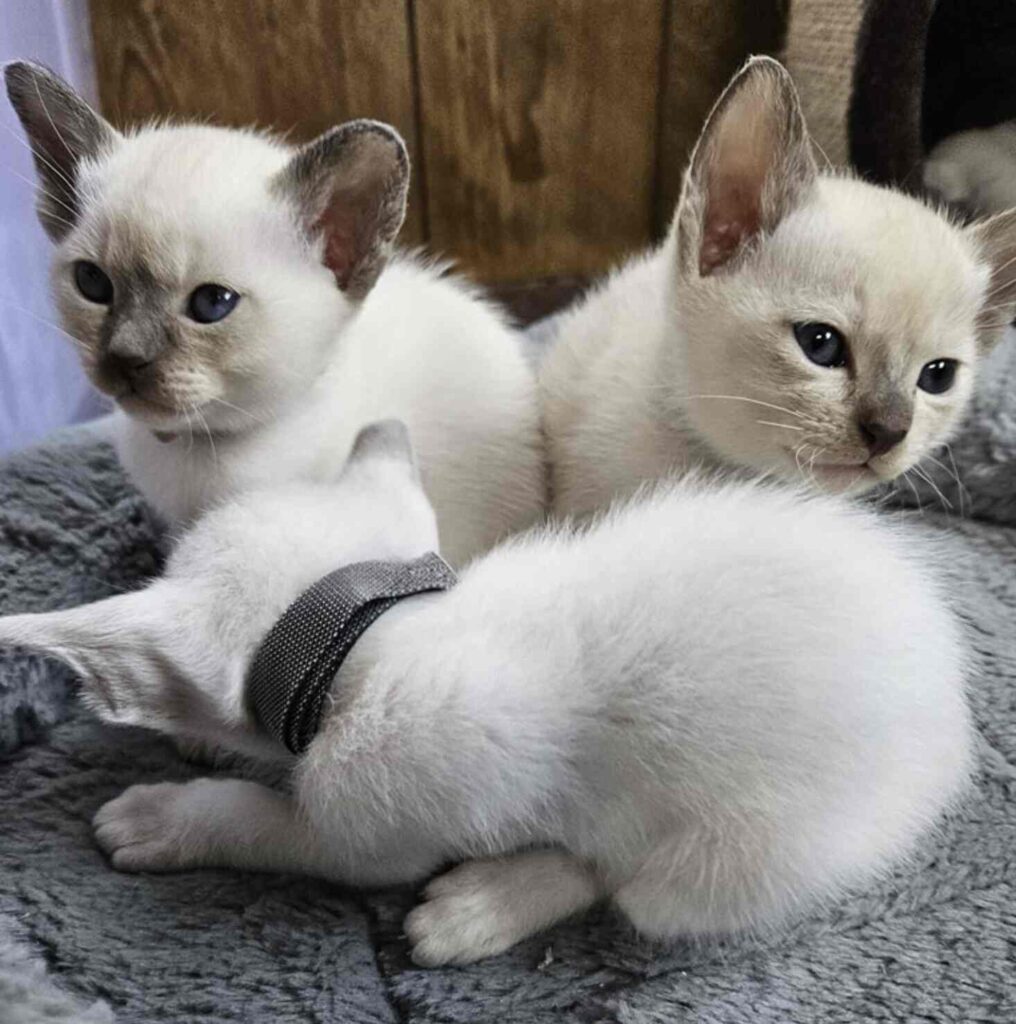
In one instance, a breeder I worked with brought in a small group of young cats for temperament observation and early health screening. During that visit, I was reminded how often people misidentify young Tonkinese cats as Siamese until their adult coat pattern and body shape fully develop. For owners looking to explore breed-specific accessories or services that help compare traits and care needs, a breed comparison resource can be useful when sorting through conflicting online information. I have seen many first-time owners rely on mixed sources, which can lead to confusion about expectations. Having structured reference points helps reduce mismatched assumptions early on.
Coat coloration also plays a role in how people perceive them. Siamese cats usually show stronger contrast points on ears, face, tail, and paws, while Tonkinese cats often display a softer gradient known as mink patterning. I have watched visitors in the cattery assume two cats were siblings simply because their coloring looked similar at a distance. Once you observe them side by side for a few days, the tonal differences become much easier to spot.\
Care, behavior, and daily interaction
From a care perspective, both breeds require consistent interaction, but they respond differently to routine. Siamese cats often thrive on predictable engagement schedules, as if they were tracking your daily habits. Tonkinese cats are more flexible, sometimes adjusting their interaction style to the household’s energy. I have seen Tonkinese cats quietly sit with a calm owner for hours without issue, while a Siamese might escalate vocal reminders for attention.
Feeding time behavior also tells an interesting story. Siamese cats in my care tended to show stronger anticipation behaviors, often waiting near feeding stations long before scheduled times. Tonkinese cats still recognize routines, but they are less likely to escalate frustration if there is a delay. That difference becomes noticeable in multi-cat environments where timing is not always perfect.
Social bonding is another area where I see consistent variation. Siamese cats frequently choose one primary person and form an intense attachment that can feel exclusive. Tonkinese cats are more likely to distribute affection across multiple people, sometimes shifting attention depending on who is available. Neither approach is better, but they create very different household dynamics over time.
Play style adds another layer of contrast. Siamese cats often prefer structured play with clear targets, such as chasing a moving object in repetitive patterns. Tonkinese cats tend to mix play with social interaction, pausing more frequently to engage with the person holding the toy. I have had sessions where a Siamese would keep going until exhaustion, while a Tonkinese would stop to rest beside me before continuing again.
Choosing between Tonkinese and Siamese
When advising potential owners in the cattery, I usually start by asking how they imagine daily interaction with their cat. If someone enjoys constant vocal communication and a strong one-to-one bond, Siamese cats often meet those expectations closely. If they prefer a slightly softer, more adaptable companion who still enjoys interaction but without the same intensity, Tonkinese cats may feel more balanced. The choice is less about appearance and more about the rhythm of living.
I also consider household structure, especially in homes with children or multiple pets. Siamese cats can thrive in active environments, but they may demand more consistent attention to feel secure. Tonkinese cats often adjust more fluidly to shifting attention patterns, which can reduce tension in busy households. I have seen both breeds do well, but success usually depends on matching expectations with behavior patterns rather than appearance alone.
Experience has taught me that neither breed is easier in general. Siamese cats require emotional engagement that feels almost constant, while Tonkinese cats require social presence that is steady but less intense. At the cattery, I learned to quickly read those differences, especially during the first 48 hours of arrival. That early window often tells me more about long-term compatibility than any breed description ever could.
After years of observing both, I still find people surprised by how subtle the dividing lines can be in real life. On paper, they seem closely related, and in many ways, they are, but daily interaction reveals two distinct ways of connecting with humans. The more time I spend with them, the more I see Tonkinese and Siamese not as competing choices, but as different answers to the same question of companionship.