How to Choose Between a Bombay Cat and a Black Cat
As a veterinarian who has spent more than a decade working with cats in daily clinical practice, I’ve had this conversation more times than I can count. A client walks in holding a sleek, jet-black cat and says something like, “Is this a Bombay cat, or just a black cat?”
The confusion is understandable. To the untrained eye, many black cats look identical. But after years of examining them, treating them, and advising owners about their personalities and health needs, I’ve learned that the difference between a Bombay cat and a typical black domestic cat goes far beyond coat color.
Sometimes the distinction matters. Sometimes it doesn’t. But it’s worth understanding what separates the breed from the color.
The First Time I Met a True Bombay
I remember my first confirmed Bombay patient. The owner drove hours just to see a vet familiar with the breed.
Seeing the cat, I understood the ‘mini panther’ comparison. Its coat shone with a unique lacquered gloss, and deep copper eyes stood out. The cat exuded calm, confident energy.
That cat behaved differently from most of the others I see in the exam room. Instead of trying to hide under the table, it climbed directly into the owner’s lap and watched me work. Bombay cats tend to be unusually social, and that first encounter matched the reputation perfectly.
But most black cats that come into the clinic aren’t Bombay at all.
A Black Cat Is a Color, Not a Breed
Many people assume “black cat” refers to a specific breed. In reality, it’s simply a coat color that appears in many different types of cats.
Most black cats I treat are domestic shorthairs, meaning they have mixed ancestry rather than a defined breed line. They can vary dramatically in personality, body structure, and health traits.
Some are lean and high-energy. Others are stocky and calm. Their eye colors range from green to yellow to gold.
That’s why I usually explain it this way to clients: a Bombay is always black, but a black cat is almost never a Bombay.
How the Bombay Breed Was Created
The Bombay breed has a very specific origin story.
In the 1950s, an American breeder named Nikki Horner set out to create a domestic cat that resembled a small black panther. She crossed Burmese cats with black American Shorthairs, eventually producing a consistent line with the signature glossy coat and copper eyes.
Because of this controlled breeding history, Bombay cats share a recognizable set of traits. They’re not just black; they’re black in a very particular way.
Over the years, I’ve examined a handful of confirmed Bombays. Each one had the same physical cues that set them apart from the average black cat.
Physical Differences I Notice During Exams
After seeing thousands of cats over the years, a few characteristics help me quickly identify a possible Bombay.
The coat is usually the first clue. Bombay cats have an incredibly smooth, tight coat that feels almost like satin. Regular black cats can have beautiful coats, too, but they often lack that uniform shine.
The eyes are another giveaway. True Bombays typically have deep copper or gold eyes, which contrast dramatically with their dark fur. Green eyes are common in mixed black cats but unusual in the breed.
Body shape also tells part of the story. Bombay cats tend to have a muscular build, a rounded head, and an expressive face. Domestic black cats vary far more in structure because their genetics are mixed.
Of course, confirmation usually requires pedigree records. Physical appearance alone can be misleading.
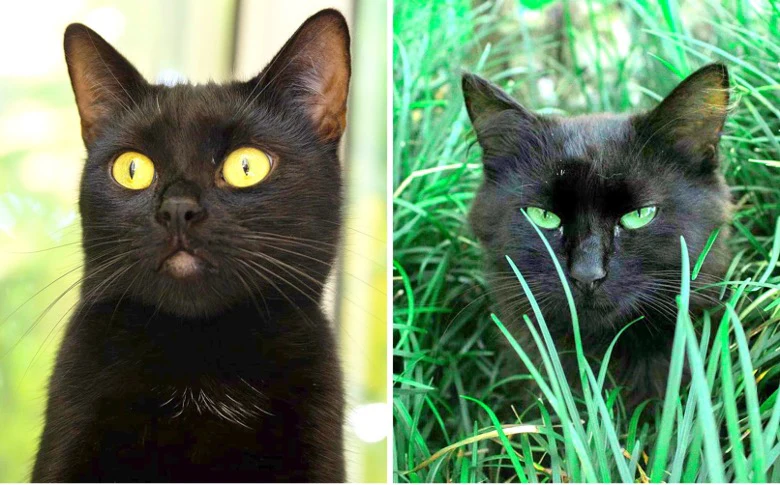
Personality Differences I’ve Seen
Behavior is where the differences often become clearer.
Bombay cats are famously people-oriented. In my experience, they behave more like dogs than typical cats. They follow their owners around the house, greet visitors, and often demand attention.
One client’s Bombay escaped its carrier to inspect the room, occasionally chirping at me during the exam.
Many black domestic cats are affectionate, too, but their personalities vary widely. Some are extremely social, while others are more independent.
That unpredictability is simply the nature of mixed ancestry.
A Common Misidentification I See
One situation comes up repeatedly in my practice.
Someone adopts a sleek black cat from a shelter and becomes convinced they have a rare Bombay. The shelter listing might even label the cat that way.
Last year, a couple brought in a rescue they believed was a Bombay because of its shiny coat and yellow eyes. The cat was beautiful, but a closer look showed a longer face, lighter bone structure, and faint brown striping in bright light—something we call “ghost tabby markings.”
That pattern often appears in black domestic cats but is rarely seen in the breed standard for Bombay cats.
Despite their disappointment, the cat was one of the friendliest I’d treated in months. Personality won out over breed.
Health Differences Worth Knowing
In daily veterinary practice, breed sometimes affects the medical advice I give.
Bombay cats, because of their Burmese ancestry, may be more prone to certain respiratory issues related to their facial structure. It’s not something I see constantly, but I’ve treated a few cases involving mild breathing difficulties.
Domestic black cats usually don’t share those breed-specific risks. Their genetic diversity often provides a broader health profile, which can be an advantage.
That said, the basic health care needs remain the same: proper nutrition, regular veterinary visits, and attention to weight management. Obesity is one of the most common issues I encounter in both.
Temperament and Household Fit
If someone asks me which is “better,” I usually push back on the question.
A Bombay cat can be wonderful for households that want a highly interactive companion. They thrive in homes where people are often around. Some become vocal if they feel ignored.
Black domestic cats can adapt to almost any environment. Their personalities range from playful extroverts to quiet observers.
I’ve seen families fall in love with both types. The key factor is matching the cat’s temperament to the home, not focusing solely on breed labels.
Why Black Cats Are So Often Overlooked
One thing that still surprises many people is how frequently black cats are overlooked in shelters.
I’ve volunteered with several rescue groups over the years, and black cats often wait longer to be adopted. Sometimes it’s because their features are harder to photograph. Other times it’s lingering superstition.
Ironically, some of the most affectionate cats I’ve met were the black ones that nobody initially wanted.
One shelter cat had been overlooked for months. Within minutes of our meeting, she climbed onto my shoulder, purring. She was adopted soon after.
The Real Difference That Matters
After years of treating cats of every breed and color, the distinction between a Bombay cat and a black cat is mostly about genetics and predictability.
Bombays come with a known lineage and a fairly consistent personality profile. Black cats are far more varied because they represent a wide range of mixed backgrounds.
But in everyday life, the experience of sharing your home with either one is remarkably similar. Both can be affectionate, playful, intelligent companions.
And in the exam room, they both tend to give me the same skeptical look when I bring out the thermometer.