Are Coyotes Really Dogs or Something Else Entirely?
I spend most of my days working as a rural animal control officer on the outskirts of a farming town, and I hear this question more often than you might expect. People see a coyote trotting across a field and assume it is just a skinny dog that got loose. I used to think the same when I first started. After years of dealing with both domestic dogs and wild predators, the difference feels obvious to me now.
Where Coyotes Fit in the Canine Family
Coyotes belong to the same biological family as dogs, which is why they look familiar at a glance. Both belong to the Canidae family, along with wolves and foxes, but that does not make them the same animal. A coyote is its own species, shaped by survival in the wild rather than by human breeding. I have handled dozens over the years, and every one of them carries a kind of alertness that domestic dogs rarely show.
People often assume that if two animals look alike, they must behave alike. That is not how it works in practice. A coyote can weigh around 9 to 18 kilograms, similar to a medium-sized dog, yet its instincts are entirely different. I have seen a coyote watch a group of chickens for nearly ten minutes before making a move, something most pet dogs would not have the patience to do.
So yes, they are related. But they are not dogs in the way most people mean it. That distinction matters more than it sounds.
Behavior That Sets Coyotes Apart
The first thing I noticed on the job was how coyotes move. They travel in straight, purposeful lines, often covering several kilometers in a single night. A pet dog, even an active one, tends to wander and double back, driven more by curiosity than strategy. The difference becomes clear when you track them after a report.
Last winter, I responded to a call where a farmer had lost a few hens. The tracks told the story before I even saw the animal. A single coyote had come in, taken one bird, and left without panic or chaos, which is a level of efficiency I rarely see in domestic dogs.
For people dealing with repeated sightings, I often suggest reaching out to a local wildlife control service that understands how to handle coyotes without escalating the situation. They know the patterns and can give advice that actually fits your area. That kind of guidance saves time and stress for everyone involved.
Coyotes are cautious. Very cautious. I have approached injured ones before, and even then, they keep a distance unless they have no other option. That natural fear of humans is one of the main reasons they survive so well near towns and villages.
Can Coyotes Be Treated Like Dogs?
This is where things get tricky, because people sometimes try to bridge the gap. I have seen cases where someone attempted to raise a young coyote like a pet. It may work for a short period, especially when the animal is small and dependent, but it rarely ends well.
A coyote does not lose its wild instincts just because it is fed from a bowl. Around the age of six to eight months, their behavior starts to shift. They become more territorial, more reactive, and far less predictable than any dog I have worked with.
One case still sticks with me. A family brought in what they thought was a stray puppy they had raised for months. By the time I saw it, the animal was already showing signs of aggression, especially around food. It turned out to be a young coyote, and rehoming it was not an option. That situation could have been avoided with a bit more awareness early on.
Dogs have been shaped by humans for thousands of years. Coyotes have not. That single fact explains most of the behavioral gap between them.
Why the Confusion Keeps Happening
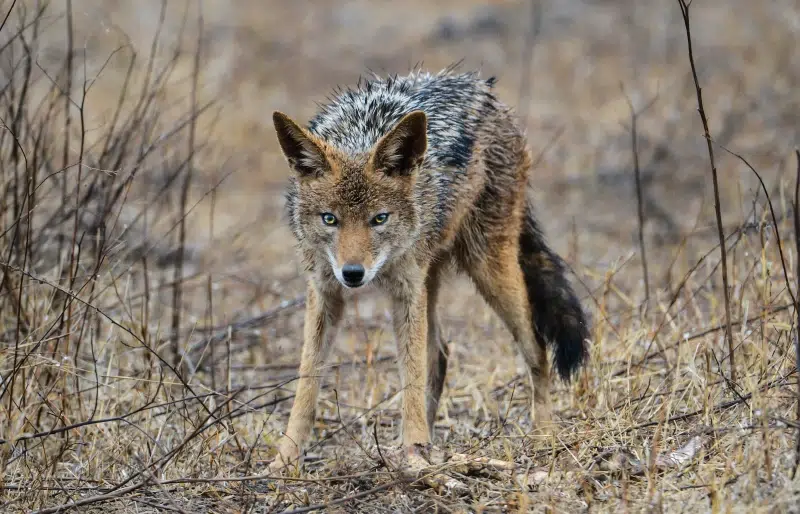
Part of the confusion comes from appearance. Coyotes can look a lot like certain dog breeds, especially lean ones with pointed ears and narrow faces. In low light or from a distance, I have even had to take a second look before making a call.
Urban expansion has also played a role. As towns spread into rural areas, encounters become more common. A person might see a coyote in their street at night and assume it is just another stray dog passing through. It is easy to make this mistake.
There is also a tendency to humanize animals. People want to believe that a wild animal can fit into a domestic role if given enough care. I understand the instinct behind that thinking, but it does not match reality. Coyotes operate on a different set of rules.
Even their vocalizations are different. A dog’s bark carries one kind of message. A coyote’s yip and howl can signal territory, location, or group coordination, and I have heard those sounds echo across open land more times than I can count.
It is a different world out there for them.
After years of working in this field, I no longer see coyotes as misplaced dogs or misunderstood pets. They are exactly what they need to be to survive, shaped by pressure, hunger, and instinct in ways that no domestic dog has to deal with. If you keep that in mind, most of the confusion fades on its own.